10-Minute Filing Check: Classify Your Role as Funded, Flat, or Exposed
Compare your function's headcount trend with the company's AI infrastructure spend in the latest filing to classify your role as funded, flat, or exposed.
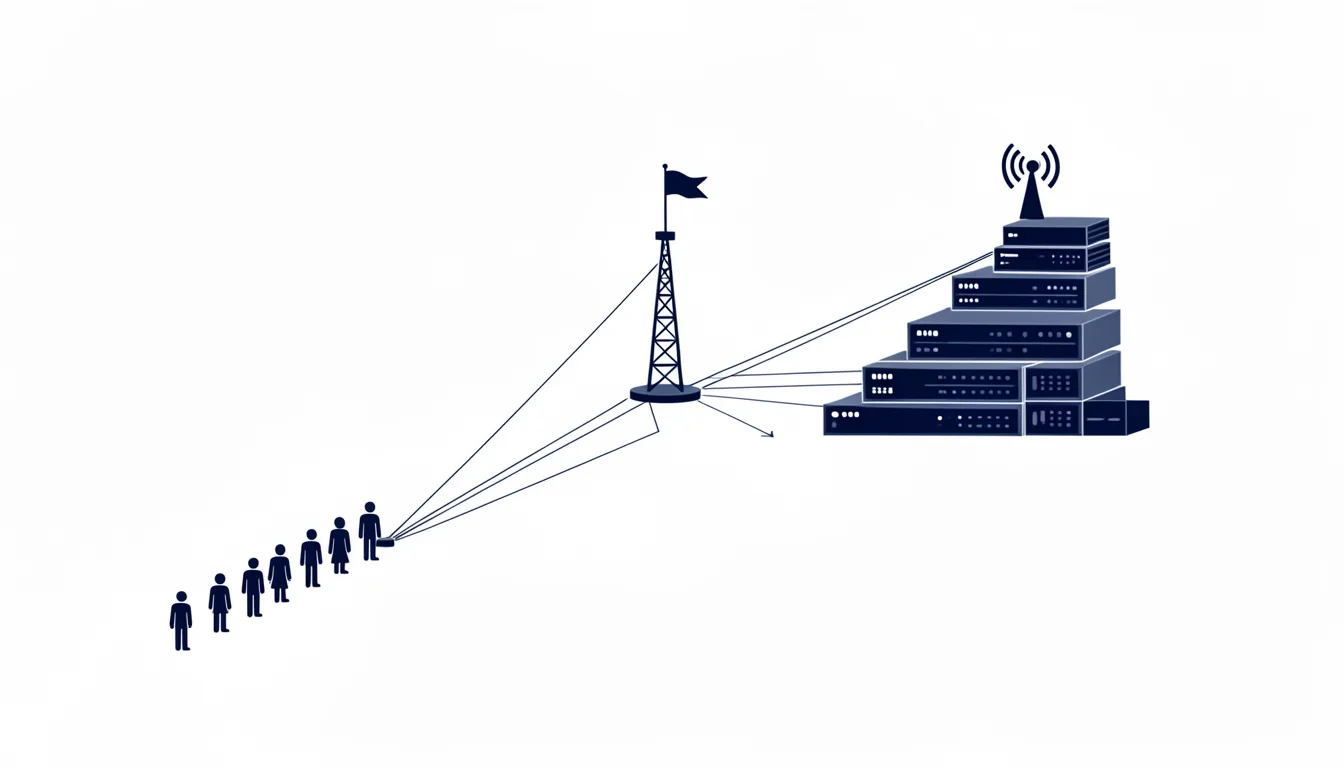
Before the next all-hands, open the latest 10-Q or annual report and find two lines: your function's headcount and the company's AI or cloud spend. A falling headcount line next to rising AI, cloud, or data-center spend is not ambiguous. A growing or holding line next to rising spend is more likely funded. A flat line next to flat spend usually means the company has not decided yet.
Oracle shows the pattern. Its global headcount dropped by about 21,000, from roughly 162,000 to roughly 141,000, over the 12 months ending May 31, 2026, a 13% decline. The company also added about $700 million to restructuring charges, raising the total to about $2.8 billion. It first cited artificial intelligence as a restructuring driver in its Sept. 11 filing.
The function table is the difference between a vague worry and a workable read. Oracle's fiscal year ending May 31, 2026 employee counts showed research and development at 43,000 after starting at 50,000, sales and marketing at 25,000 after starting at 31,000, and services at 34,000 after starting at 37,000.
The filing shows where the company is placing money
Headcount shows where the company is placing people. Spend shows where it is placing money. When those two directions disagree, the spend line usually tells you where the next year is going. When they agree, the risk is more immediate.
Oracle is investing billions in AI and cloud infrastructure while restructuring to improve efficiency and control expansion costs. Its net property, plant and equipment increased from $99,957 million as of May 31, 2026 to $127,845 million as of August 31, 2026.
The expense lines show where the company is trimming labor and overhead while the infrastructure line grows. If your function's expense is falling while its headcount is falling, the company is not just adjusting roles. It is shrinking the cost base.
Revenue can help, but it is not the whole story. Oracle's cloud revenue increased from $7,186 million in the three months ended August 31, 2025 to $11,607 million in the three months ended August 31, 2026. Research and development expense decreased from $2,491 million in the three months ended August 31, 2025 to $2,401 million in the three months ended August 31, 2026. Sales and marketing expense decreased from $2,063 million in the three months ended August 31, 2025 to $1,811 million in the three months ended August 31, 2026.
The check turns two lines into a label
Run this check when the rumor is fresh, not after the next all-hands. You need the latest 10-Q, a quarterly filing, or annual report, the function-level headcount table, and the AI or cloud spend line. You are getting a defensible read on your function, not an analyst's full opinion.
- Find the latest 10-Q or annual report and open the employee-count table. If your company does not break out functions, use the closest proxy: technology, product, sales, services, or operations.
- Write down your function's starting and ending headcount. Note the direction, not just the number.
- Find the AI, cloud, data-center, or infrastructure spend line. Look for property, plant and equipment, capital expenditure, or a disclosed AI build-out.
- Compare the two directions. Mark exposed when your function is falling while infrastructure spend is rising; mark flat when your function is flat and spend is rising; mark funded when your function is growing or holding while spend is rising.
- Check the restructuring charge. If the company added a new charge and named AI as a driver, treat that as a confirmation signal, not a footnote.
The label gives you a question to bring to the next planning meeting: Is my function being funded, held, or exposed by the AI build-out? Write the answer down before the meeting.
The label tells you what to do next
Funded means the company is paying for your function's future. Flat means the company has not committed either way. Exposed means the company is paying for something else and your function is the cost of that something else.
Earlier AI demand signals can sharpen the read. Oracle's GPU consumption for AI training grew 244% in the 12 months before March 10, 2025. In Oracle's fiscal 2025 third quarter, remaining performance obligations, a measure of future contract revenue, reached $130 billion, a 62% increase in USD versus the prior-year quarter. During Oracle's fiscal 2025 third quarter, IaaS cloud revenue, the infrastructure-as-a-service line, reached $2.7 billion, a 49% increase in USD compared with the same quarter a year earlier.
Do this week: pull the latest filing, mark your function's headcount direction, mark the AI spend direction, and write down one label: funded, flat, or exposed.